Most operators have rooms full of air-cooled racks and a plan to add denser ones. Few want to rebuild the room to do it. The budget question is how to add liquid cooling a few racks at a time, without ripping out the air system that keeps everything else running.
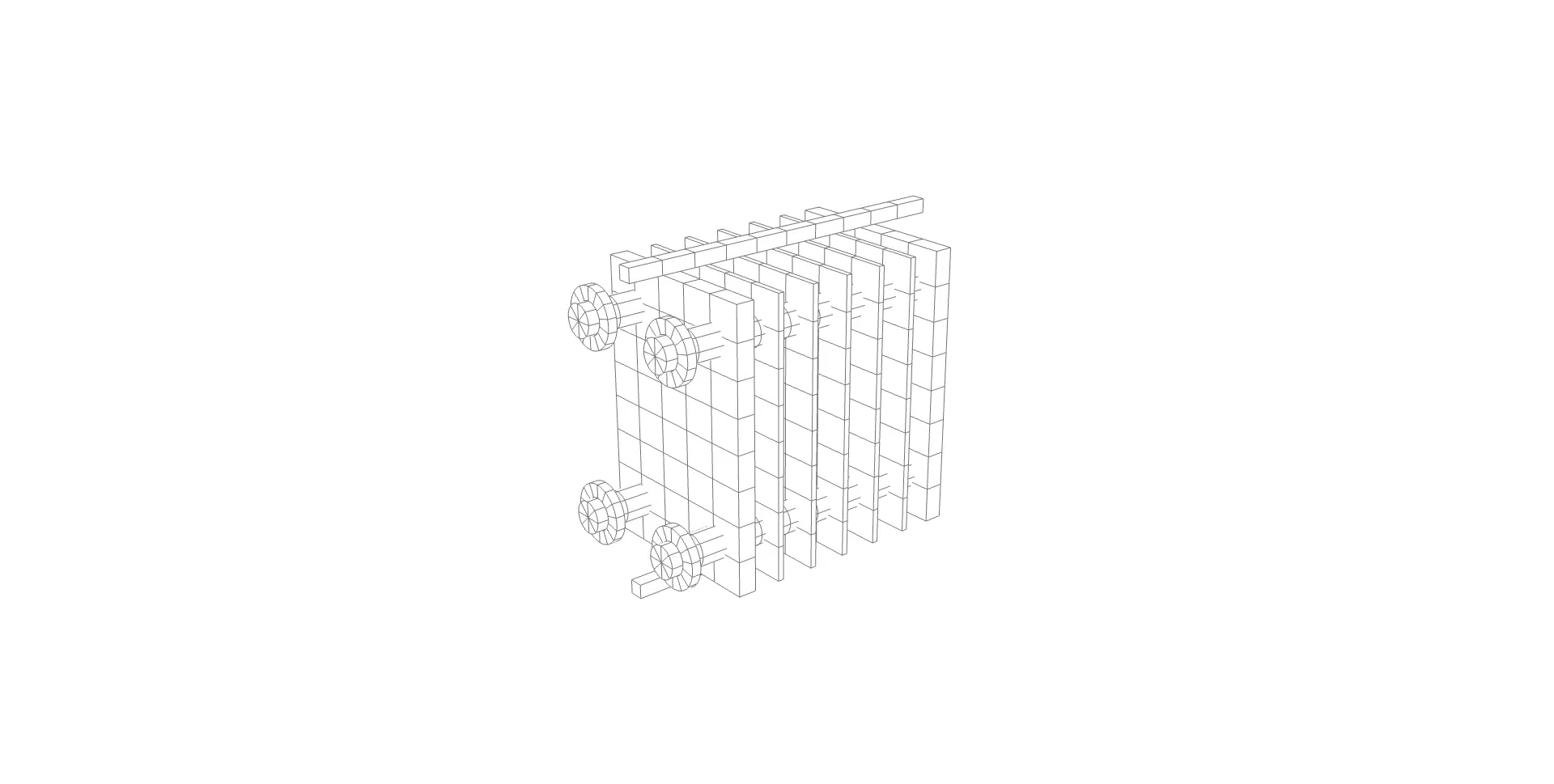
So we read Data Center Frontier's explainer on data center cooling with that question in mind. It walks through air, evaporative, liquid, and hybrid cooling without favoring any of them, and its conclusion is that most rooms will end up hybrid: air for ordinary servers, liquid to the chips for the densest ones. For a room in between, it points to the rear-door heat exchanger, a water-cooled radiator that replaces the back door of the rack. The server's own fans push hot exhaust through it, the water carries the heat away, and the room's air handlers see much less load. No server has to change.
We agree that rear doors are the sensible first step for an existing room. Our question is about the fans.
Fan power rises fast
The explainer makes a point that applies directly here: fan power rises with the cube of fan speed. Run a fan a quarter faster and it uses roughly twice the power. Run it a fifth slower and it uses roughly half. Small changes in speed are big changes on the electricity bill, and with data center electricity use projected to roughly double by 2030 (the explainer cites the International Energy Agency), that bill matters.
A rear door adds resistance. Air that used to leave the rack freely now has to pass through a coil of tubes and fins, and the fans have to work harder to push it. A door's spec sheet gives a heat capacity, in kilowatts, at a rack inlet temperature and a water flow. It rarely gives the air-side resistance at that capacity, or the fan power it takes to overcome it. A door that moves heat well but blocks air can cost back on the fans part of what it saves on the room.
Where we come in
A heat exchanger's job is to move heat well and let the fluid through easily, and those two pull against each other. Packing in more surface catches more heat and blocks more air. Conventional coils are built from stamped fins and tubes, which fixes the shape and the trade-off with it. We 3D print ours, which lets us shape the channels for heat transfer and easy flow at the same time. Our 1 MW heat exchanger, built for the Open Compute Project's Deschutes cooling design, is one example. Printing can do the same for a door coil, with fins and air paths shaped to catch heat while keeping air-side resistance low.
What operators should ask for
When a door vendor quotes a capacity, ask for the air-side pressure drop and the fan power that goes with it at that capacity. A rating without those two numbers is half a spec sheet, and we're holding ours to the full one.